|
COASTVAX - CARIBBEAN SEA
Please use our A-Z to navigate this site or return HOME
DESIGN DRAFT - The filtration module, cargo hold and offloading mechanism is shown in red in outline form in the above diagram. The system consists of several integrated components, incorporating motors, pumps, hydraulics, electronics and computer programs - all to be powered by energy from nature - to avoid creating greenhouse gas emissions. You can see from the level of integration that such a system would not lend itself to a bolt-on item for existing vessels. The vessel has to be custom designed and built.
SHORES AROUND THE CARIBBEAN SEA
The Caribbean Sea operates as a massive, high-velocity marine highway. Driven by the persistent Caribbean Current (formed by the convergence of the North Equatorial and Guiana Currents entering from the east) and strong trade winds, warm surface waters sweep westward across the basin at 0.5 to 1.0 knots before splitting, discharging through the Yucatán Channel into the
Gulf of
Mexico, or upwelling along Central America.
Oceanographic Mechanics: As the westward-flowing Caribbean Current hits the Central American landmass (Panama, Costa Rica, Nicaragua), it forms a major regional counter-clockwise eddy known as the Costa Rica Thermal Dome and the Panama-Colombia Gyre.
COASTAL CLEANER SIDE VIEW V1 - This is a draft design for a coastal/river experimental rig based on the SeaVax concept from March 2019. Unlike SeaVax, this low budget development boat was to be built of steel, not aluminium, to keep the up front costs down, though long-term use would favour aluminium alloys. As to economics, who might pay for the operations of such a vessel locally remains to be answered. Unlike a dustcart that collects household waste, there is no immediately obvious health hazard from not cleaning or monitoring the oceans, rather it is out of sight, toxic, cumulative and just as deadly. We are no longer promoting wind power, the state having shown no interest in that method of propulsion. It will need someone with deeper pockets and more influence, to carry that particular torch. The good news being, that the craft is far less complicated design wise.
DRAFT COASTAL DESIGN - These diagrams show a single 1.5kW wind turbine mast, an experiment that was planned for 2020 funding dependent - that never materialised. This version uses 36 solar panels to give 6.9kW (9.25hp) per hour energy harvesting in sunlight. It is worth noting that a small craft like this offers only one eighth the efficiency of the full size SeaVax machines. The solar panels were of the cheaper variety to contain costs, but since then, prices have tumbled, making solar power more attractive.
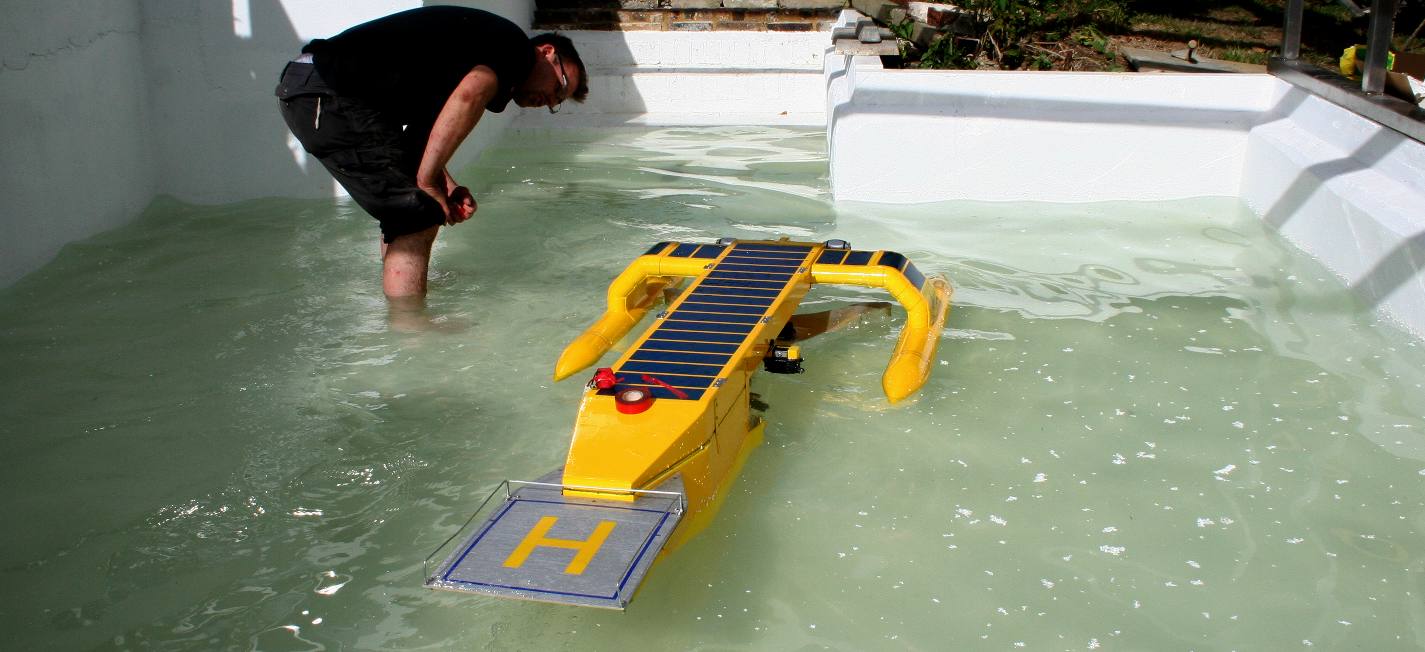
TESTING - Chris Close (Project Director 2015-2017) is seen here watching the SeaVax proof of concept boat filter plastic particles from water in our test tank facilities, in this case small polystyrene pieces were scattered on the surface and recovered using twin hydrocyclonic chambers to trap the plastic, while clean water was returned to the tank. Simple, and it worked. We designed and built the craft in house.
THE UNITED NATIONS UNEP - Could SeaVax be a part solution for UN goals? CAPEX AND OPEX - What level of G20 investment is required? GHOST FISHING GEAR - Drowning fish, mammals and reptiles, and animal poisoning HEALTHIER OCEANS & BLUE GROWTH - What are the health benefits? INVESTABILITY - Can SeaVax 2.0 AI be a commercial success? WHERE DOES AI COME IN? - Will artificial intelligence make a difference? WHAT IS THE MARKET VALUE OF OCEAN PLASTIC? - Is it worth fishing for marine plastic? CERTIFICATION - How will the ocean plastic be verified for credits? WORLD BANK, IMF & UNEP - Are there any match funding opportunities? CIRCULAR (PLASTIC) ECONOMY - FISHING GROUNDS PATENT APPLICATION - GB2622325.5 23rd September 2026 PATENT ABSTRACT - DESCRIPTION - CLAIMS - ACCELERATION SARGASSUM CHAIN - The 5,500 mile bloom, 33 million ton Atlantic belt? SARGASSUM $VALUE - Where is the dollar value in recovered treated brown sea weed? THE CARIBBEAN - Gulf of Mexico, Cancún, Tulum - Barbados, Saint Lucia, Martinique, Guadeloupe, Dominican Republic & Puerto Rico
COASTVAX (CVAX) - Ballpark budget 10-14 meter coastal prototype - self build concept CVAX SHIPYARD - Commercial construction estimates 5083 and 6082 alloys CVAX SOLAR POWER - Wing panels stressing and hydraulic gearbox calculations for 30 knot winds CVAX UK - Blue channels for coastal operations: Bristol, Lyme Bay, Celtic Sea, Dover Straits, Irish Sea CVAX MEDITERRANEAN - Blue channels (Libya, Egypt, Cyprus, Aegian, Adriatic, Alboran, Balearic, seas CVAX GULF OF MEXICO - Yucatan Channel, Campeche Bay, Florida Straits, Texas Islands CVAX CARIBBEAN - Colombia, Costa Rica, Belize, Haiti, Honduras, Jamaica, Nicaragua, Panama, Venezuela
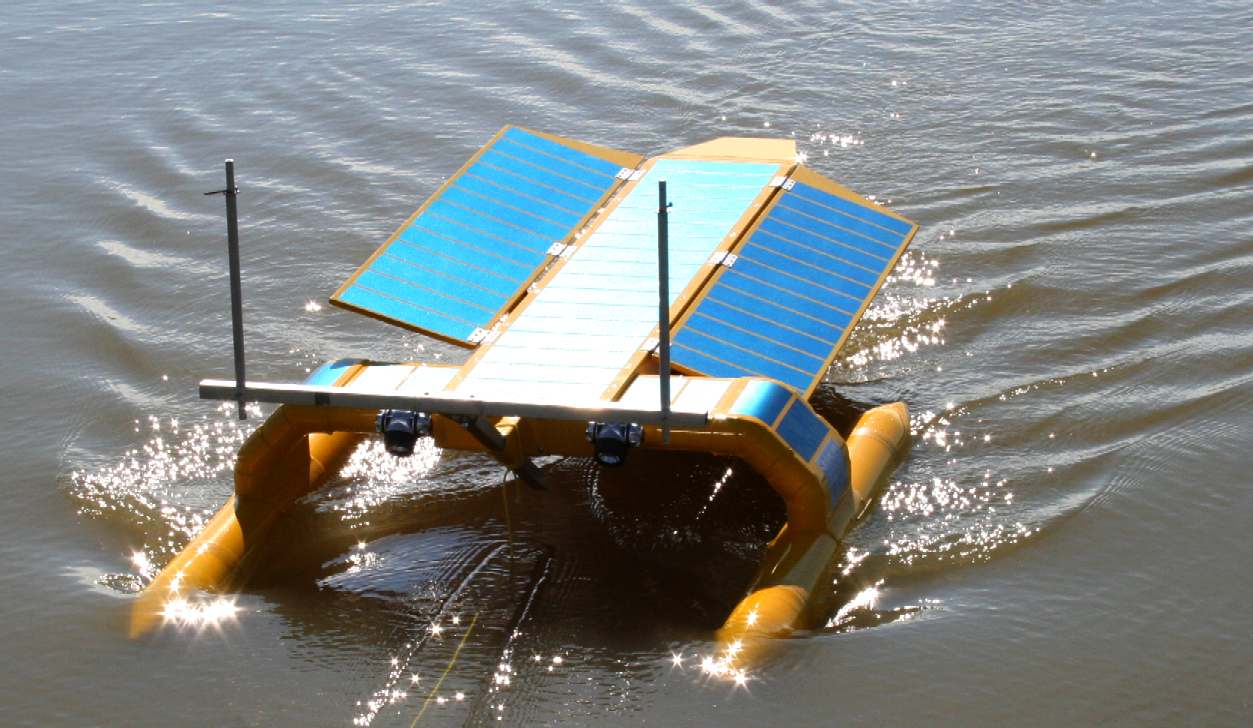
OPEN WATER - SeaVax is seen here during open water floatation trials. Please note that this is a small (proof of concept) version of any ocean or river floating dustcart that we hope will be tested on the south coast of England as the project progresses. SeaVax is a selective filtration machine that can be configured to target solid plastics and particles. The machine could also be used in oil spill emergencies, or as a selective fishing vessel. The platform could thus be useful in many ways.
There are 5 swirling ocean garbage patches, filled with marine litter/plastic, called gyres. That said, we will not be looking any further than UK and Mediterranean littoral coastlines and rivers with any CoastVax test rig - if we get that far. As we say, the idea is the easy part. Funding, is another matter. That is in the hands of the gods and the will of the people.
LINKS & REFERENCE
https://www.
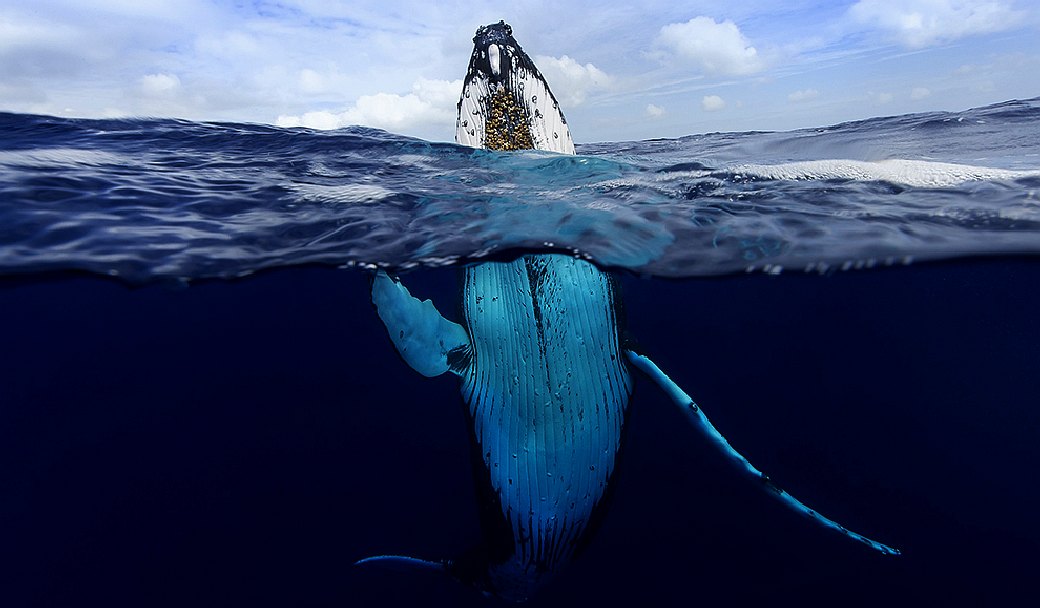
MARINE LIFE - This humpback whale is one example of a magnificent animal that is at the mercy of human activity. Humans are for the most part unaware of the harm their fast-lane lifestyles are causing. We aim to change that by doing all we can to promote ocean literacy.
|